
It's been about six months since my last market update, and while the Toronto real estate market continues to move at a considerably slower pace than we've grown accustomed to, things have been anything but quiet on our end. In fact with two months still remaining in 2026 I’ve already set a new sales record for myself…I'm incredibly grateful to the clients who continue to put their trust in me and Andrew, particularly in a market where thoughtful advice, creative solutions, and a little extra patience can make all the difference.
But enough about us. Let's talk about what's happening out there!
Four years of waiting for the market to turn.
If you've been following Toronto real estate over the past few years the story probably feels familiar. The number of buy and sell transactions remains at 30 year lows, prices have slowly, steadily, softened from their 2022 peaks, and the much-anticipated market recovery continues to be just around the corner.
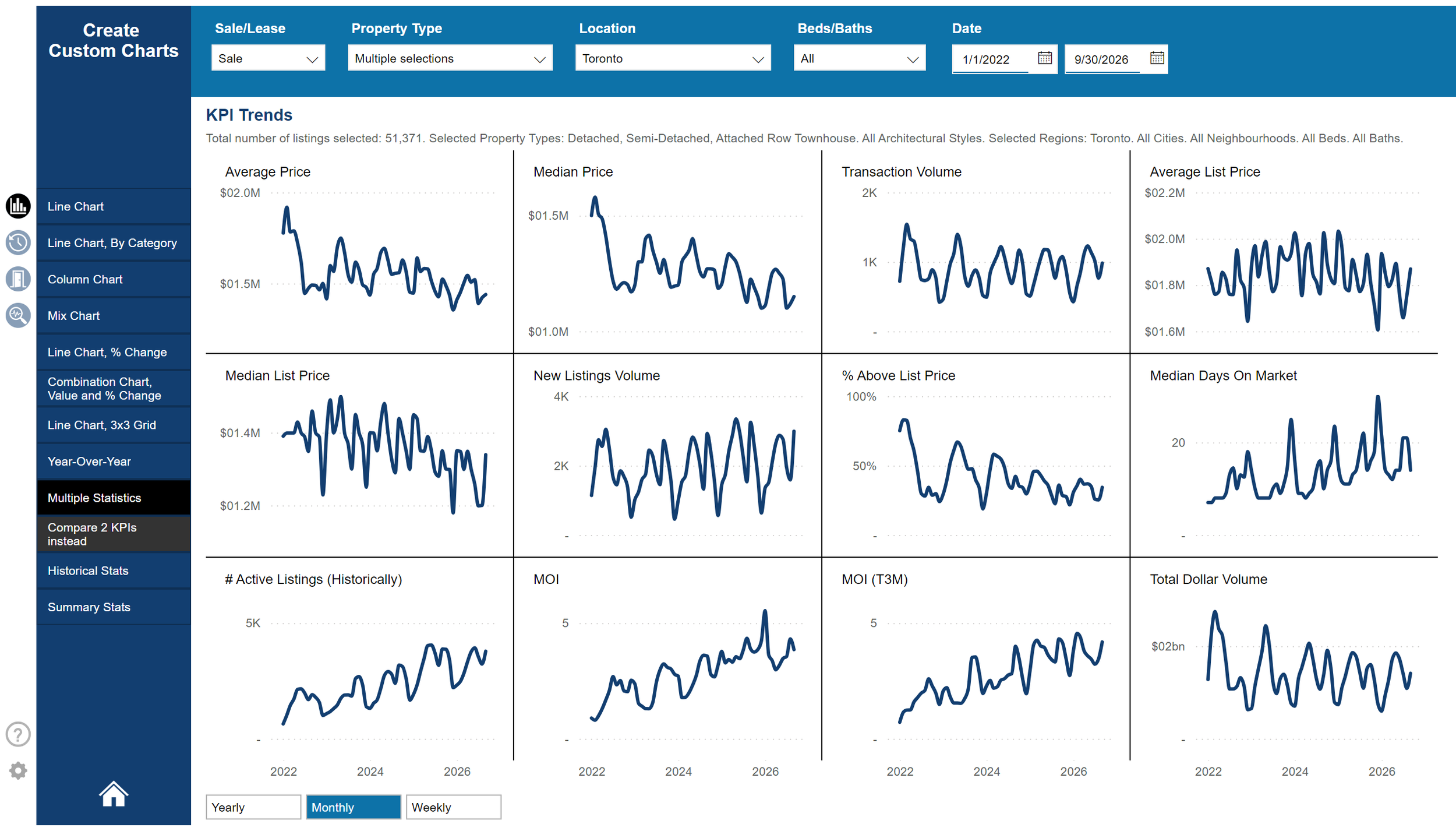
City of Toronto multiple key stats, Freehold homes (no condos), January 2022 to September 2026. Source: TRREB
It's a hot-and-cold market.
One of the most striking things I'm seeing is just how dramatically the market can differ from one property to the next. A beautifully renovated freehold in a desirable neighbourhood can still occasionally attract 5-10 offers, sell well above asking, and leave everyone wondering what happened to the supposedly slow market. But those properties represent an increasingly small slice of the pie.
For much of the market, buyers are taking their time, properties are sitting longer, and sellers are having to adjust their expectations. We're even seeing some individual properties trade at prices we saw back in 2018 or 2019.
The takeaway? There's no longer one Toronto real estate market. Property type, neighbourhood, condition, pricing, and presentation can produce wildly different outcomes. And that's why understanding what buyers actually want and positioning a property accordingly has arguably never been more important.
Selling for less doesn't necessarily mean losing.
This is probably one of the most important conversations I've been having with homeowners lately. Many people are reluctant to sell because their property is worth considerably less than it was a few years ago. I get it. Nobody likes seeing the value of their biggest asset decline. But here's something that often gets overlooked: if you're selling to buy something more expensive, a declining market can actually work in your favour.
Let's say you own a condo that was once worth $900,000 but would now sell for $700,000. That's a $200,000 decline. Not exactly exciting.
But imagine the house you're hoping to move into was previously worth $1.5 million and is now available for $1.2 million. You've lost $200,000 on your sale, but you're saving $300,000 on your purchase.
You're actually $100,000 ahead compared with making that same move at the previous prices.
Of course, every situation is different, and financing costs, transaction expenses, and the relative performance of different property types all matter. But the point is that the market value of your current home is only half the equation. Sometimes the best opportunities emerge in markets that don't feel particularly encouraging.
For buyers, patience is a virtue. But so is being ready to pounce.
You'd think a slower market would make life easy for buyers. Not necessarily. One of the biggest frustrations I'm hearing from my buyer clients right now is the lack of genuinely good inventory. Yes, there are plenty of listings. But finding a property that checks the right boxes, in the right neighbourhood, at a price that makes sense? That's another story. I suspect part of this comes down to sellers who simply don't need to move choosing to wait for what they deem to be better market conditions. And this creates an interesting contradiction: we have a relatively soft market, but when some of the most desirable properties do come to market, they are quickly bought up by those buyers who have been eagerly awaiting them.
My advice to buyers is to be patient, but prepared. Don't compromise on the things that matter just because you feel like you should be buying right now. At the same time, when the right property comes along, recognize that you're buying a home to live in not just an investment to trade.
Which brings me to my final point.
Are we finally near the bottom?
I wish I had a crystal ball. We've spent the better part of three years wondering when Toronto's market will turn around. And while I still suspect we're getting closer to a bottom than we were a year or two ago, nobody can reliably predict exactly when that will happen. Could prices fall further? Absolutely. Could a shift in confidence, interest rates, or economic conditions bring buyers back into the market more quickly than expected? Also possible.
But here's what I keep reminding clients: you don't need to perfectly time the bottom to make a great real estate decision. If you're buying a home you love, can comfortably afford, and plan to enjoy for years to come, whether you purchased at the absolute bottom will probably matter a lot less than you think. And if you're selling and buying in the same market, the opportunity may be better than the headlines suggest.
Ultimately, the right decision isn't about predicting what Toronto real estate will do next. It's about understanding what makes sense for you.
And that's where good advice really earns its keep.
-Steve
